
Transcript processing, and the words respondents never said.
Transcript processing is one of the mechanically slowest steps in a qualitative evaluation. Recorded interviews and focus group discussions have to be transcribed, corrected for accent and terminology, structured against the evaluation questions, and analysed both individually and across the full transcript set. On a typical assignment with fifteen or twenty interviews this can take one to two weeks before any analytical work starts.
Four ways a transcript gets misrepresented.
At the individual transcript level, the most common failure is invented content attributed to real respondents. A model asked to clean, structure, and summarise a transcript will smooth over unclear passages by producing text that reads naturally but was not what the respondent actually said. Half-finished sentences get completed. Ambiguous phrasing gets resolved into a specific meaning the respondent did not commit to. Quotes appear in the deliverable that the respondent never spoke. This is the failure mode that carries the greatest ethical weight.
The second individual-level failure is sentiment and meaning misreading, particularly in low-resource languages and in code-switching between languages. Standard transcription and coding tools trained predominantly on North American English routinely misread tone, sarcasm, and evaluative weight in Somali, Amharic, Arabic, or French-inflected regional variants. A statement that was clearly critical in the original language can appear neutral or even positive once processed. The evaluator working from the processed output has no way to see what was lost.
Four structural controls, each answering a specific failure mode.
Verbatim-anchored processing answers invented content. Every processed transcript is required to preserve the verbatim source alongside any cleaned or structured version. Where the AI has smoothed unclear passages, cleaned up disfluencies, or completed a truncated sentence, this is marked in the deliverable and the original passage is retained beneath. Quotes carried forward into the cross-stakeholder analysis are required to match the verbatim source, not the cleaned version. This means the evaluator, and any reader who later inspects the transcripts, can see exactly what was said and exactly what was changed.
Context-specific correction answers language and meaning misreading. Before processing, the AI is trained on programme-specific vocabulary from the evaluation documents: organisation names, place names, sector terminology, technical jargon. Where the assignment involves low-resource languages or code-switching, the model is used for structure and mapping but sentiment and evaluative weight are extracted directly from the source language passage rather than from a translation. A native-speaker evaluator or field partner reviews sentiment codes on a sample of transcripts as part of the standard workflow.
Processed transcripts, a cross-stakeholder analysis, sentiment review notes, a disclosure.
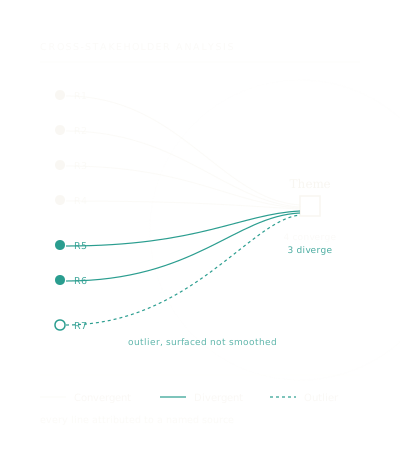
Every Meridian transcript-processing assignment produces four artefacts. The processed transcripts themselves, each preserving the verbatim source alongside the cleaned and structured version, with EQ-mapping marked against the evaluation matrix. The cross-stakeholder analysis, structured by evaluation sub-question, reporting convergence, divergence, and outlier perspectives with named-source attribution and verbatim excerpts for every theme. The sentiment review notes, where relevant, documenting the language-specific decisions taken during processing and any sentiment codes flagged for evaluator or field-partner review. And the disclosure text, a short methodology annex drafted for inclusion in the evaluation report.
The named-source attribution is what makes the cross-stakeholder analysis inspectable. When a client, donor, or external reviewer asks how a particular theme was substantiated, the answer is a named list of respondents and their verbatim statements. When a client asks whether there was disagreement, the answer is the specific respondents who disagreed and what they said. This is not the standard output of AI-assisted transcript work in the sector. It is what makes the analysis defensible.
The differentiation is the discipline.
Transcript processing is the capability where AI failure carries the greatest ethical weight, because the subjects are real people who spoke on record and can be misrepresented. Verbatim preservation and named-source attribution keep the reader in contact with what was actually said. When a client asks who spoke to a theme and what they said, the answer is a name and a quote, not a summary.