
Contribution analysis and process tracing, and the failure with no signature.
Contribution analysis and process tracing are the two theory-based causal inference methods that answer the question every serious evaluation eventually reaches. Did the programme contribute to the observed change, and if so, how much and through what mechanism? Both are used where counterfactual designs are not available or not credible, and where the honest answer to the causal question is not attribution but contribution.
Applying AI to this work carries risks that are different in kind from the other capabilities Meridian delivers. Elsewhere, the failure modes have visible signatures. A fabricated outcome has no source. An invented quote does not match the transcript. Here, the failure mode has no signature. A contribution narrative written by a model reads exactly like one grounded in rigorous link-by-link assessment. A process tracing write-up with test types assigned after the evidence was read reads exactly like one with predictions locked in advance. The output is fluent, correctly formatted, and methodologically worthless.
Failures with no visible signature.
The most dangerous failure in contribution analysis is coherent narrative produced independently of the evidence. A model asked to write a contribution story will produce one that reads as credible, because narrative coherence is what it optimises. Coherence is generated regardless of whether the underlying evidence supports the links being asserted. The result passes the method's own quality test on inspection. A reader, including the evaluator who commissioned it, cannot distinguish a well-evidenced contribution narrative from a well-written one by reading it. The failure has no signature. The output looks exactly like success.
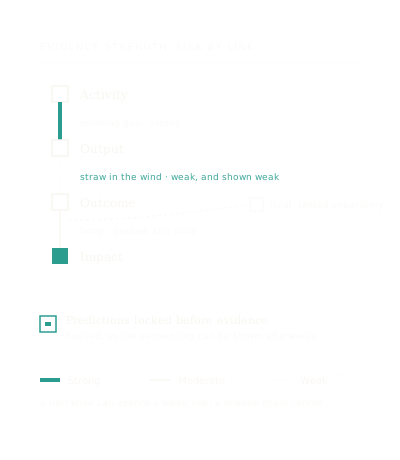
Related to this is smoothing. Given a results chain with three strong links and two weak ones, a model will write five links that read equally solid, because connective tissue is generated at uniform confidence. The distribution of evidence strength across the chain, which is the most important thing a reader of a contribution analysis needs to understand, disappears into prose that flows too well.
Five structural controls, each answering a specific failure mode.
Register before narrative answers coherent-narrative-without-evidence. The link-by-link evidence assessment exists as a structured register before any prose is drafted. Every link in the results chain carries its evidence, its sources, and a strength rating assigned by the evaluator. The contribution narrative is then a rendering of the register, not a document written and sourced afterwards. What is checkable is the register. Prose written first and sourced afterwards is how an unsupported contribution claim acquires a bibliography, and the workflow makes that sequence structurally impossible.
Visible strength shading answers smoothing. The register export produces a client-facing workbook that colours every link cell by its evidence strength. A reader sees the distribution across the chain at a glance. Where the evidence is solid, where it thins, and where it runs out. A narrative can absorb a weak link. A table shaded by evidence strength cannot. An automated check compares the draft narrative against the ratings and flags weak or absent links written in confirming language.
A register, a locked prediction set, a narrative rendered from ratings, a factors sheet, a disclosure.
Every Meridian contribution analysis or process tracing assignment produces four or five artefacts depending on which method is applied. For contribution analysis: the links register, showing every link in the results chain with its evidence, sources, and strength rating; the exported client-facing workbook, with strength shading visible across the chain and every link readable in the context of the whole; the external factors sheet, showing each factor, its evidence, its disposition, and the basis for it; and the contribution narrative, rendered from the register with language calibrated to the ratings. For process tracing: the hypothesis and rival register with origins recorded; the locked prediction set for each test, with the hash preserved as evidence of the sequencing; the test results with every verdict carrying a verbatim excerpt and location; and the write-up with inferences that match what each test permits. Both methods produce the disclosure text, a short methodology annex drafted for inclusion in the evaluation report.
The artefacts together are what make the causal reasoning inspectable. For contribution analysis, the shaded workbook is the most useful thing to put in front of a client who is sceptical that a plausible story is an evidenced one. The register in both cases is what preserves the audit trail from causal claim through to reported finding.
The differentiation is the discipline.
The methods are contribution analysis and process tracing as they have been practised for over two decades. The failure modes are named in the research on interpretive causal analysis and language model behaviour. The controls are structural rather than prompted, and stronger here than anywhere else in the practice. This is a workflow designed by someone who has read the research on what goes wrong when AI is used carelessly for causal reasoning, and has built the workflow around the answer.